
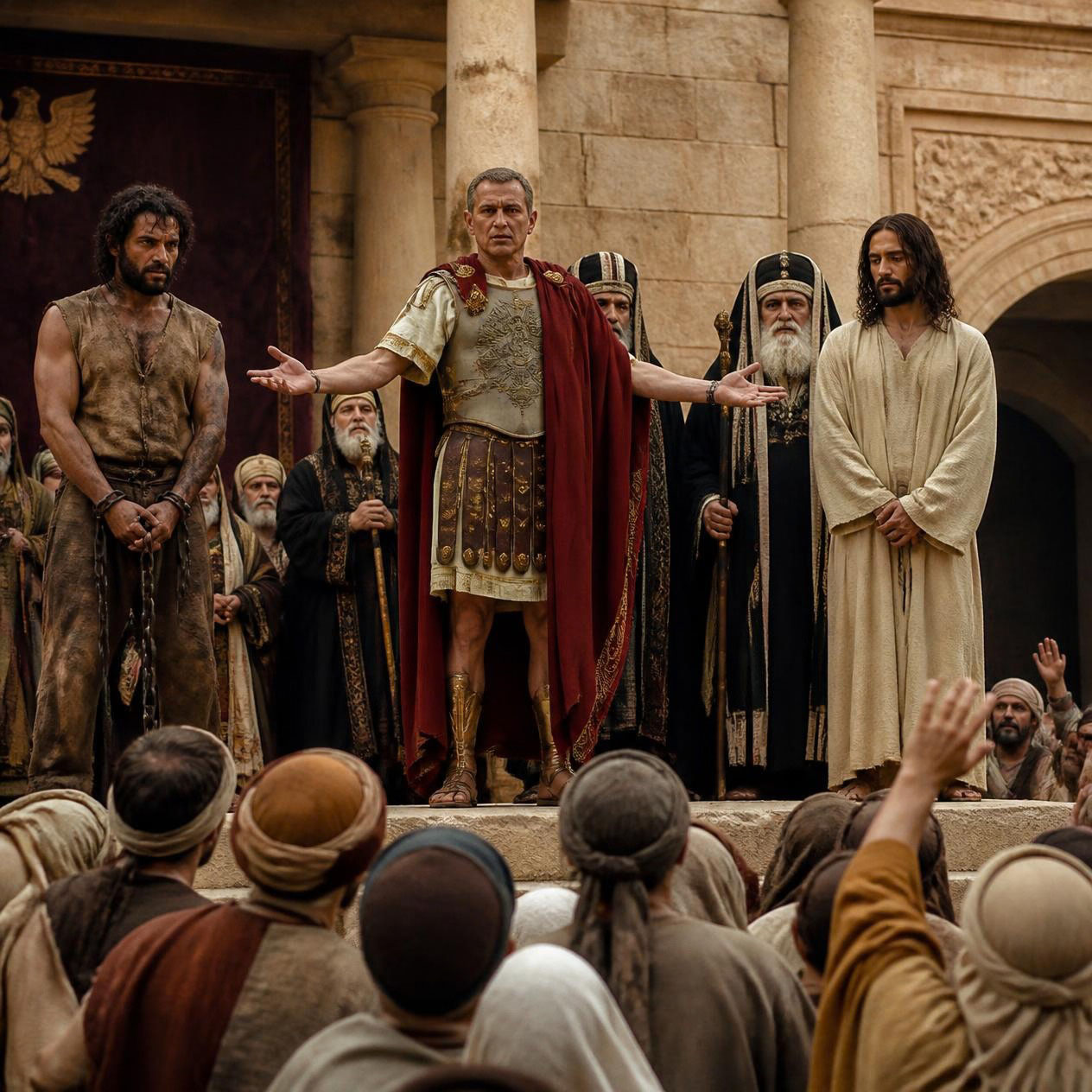
Barabbas (full name “Jesus Barabbas,” meaning “son of the Father”) was a notorious criminal imprisoned for insurrection and murder. During the Passover feast, he was released by Pontius Pilate in place of Jesus.
Joseph Caiaphas and the Sanhedrin: The high priest and the Jewish council perceived Jesus as a direct threat to their religious authority and social order, ultimately charging him with blasphemy. During the proceedings, Pontius Pilate exercised the Roman tradition of pardoning a prisoner selected by the public during the Passover festival (Matthew 27:17), presenting the assembled crowd with a critical choice:
Matthew 27:17
“Therefore when they were gathered together, Pilate said unto them, Whom will ye that I release unto you? Barabbas, or Jesus which is called Christ?”
Manipulated by the chief priests and elders, the crowd aggressively demanded the release of Barabbas instead of Jesus (Mark 15:11 – “But the chief priests moved the people, that he should rather release Barabbas unto them.”). Although Pilate formally declared Jesus innocent (Luke 23:3 – 4 – “And Pilate asked him, saying, Art thou the King of the Jews? And he answered him and said, Thou sayest it. Then said Pilate to the chief priests and to the people, I find no fault in this man.”) and repeatedly appealed to the people on His behalf—doing so three separate times (Luke 23:15–16 – “I will therefore chastise him, and release him. (For of necessity he must release one unto them at the feast.)”, 23:20 – “Pilate therefore, willing to release Jesus, spake again to them”, 23:22– “And he said unto them the third time, Why, what evil hath he done? I have found no cause of death in him: I will therefore chastise him, and let him go.”)—the mob only grew more relentless, deafeningly shouting, “Crucify him!” and “Not this man, but Barabbas!” (John 18:40 – “They cry again, saying, Crucify him, crucify him. Pilate saith unto them, Shall I crucify your king? The chief priests answered, We have no king but Caesar.”).
Pontius Pilate washed his hands in front of the crowd, declaring, “I am innocent of this man’s blood; see to it yourselves” (Matthew 27:24), and then:
Matthew 27:24
“When Pilate saw that he prevailed nothing, but that an uproar was made, he took water, and washed his hands before the multitude, saying, I am innocent of the blood of this just person: see ye to it. Then answered all the people, and said, His blood be on us, and on our children.”
The narrative stands as one of the most vivid illustrations of substitutionary atonement in Scripture: the guilty were pardoned while the innocent suffered in their place. Peter later echoed this profound truth in Acts 3:14–15:
Acts 3:14–15
“But ye denied the Holy One and the Just, and desired a murderer to be granted unto you; and killed the Prince of life, whom God hath raised from the dead; whereof we are witnesses.”
The profound theological truth is that all who place their faith in Christ share the destiny of Barabbas—granted absolute freedom despite their own guilt, because Jesus willingly bore the punishment they rightfully deserved (2 Corinthians 5:21; Romans 5:8).
2 Corinthians 5:21
“For he hath made him to be sin for us, who knew no sin; that we might be made the righteousness of God in him.”
Romans 5:8
“But God commendeth his love toward us, in that, while we were yet sinners, Christ died for us.”
Leave a Reply