
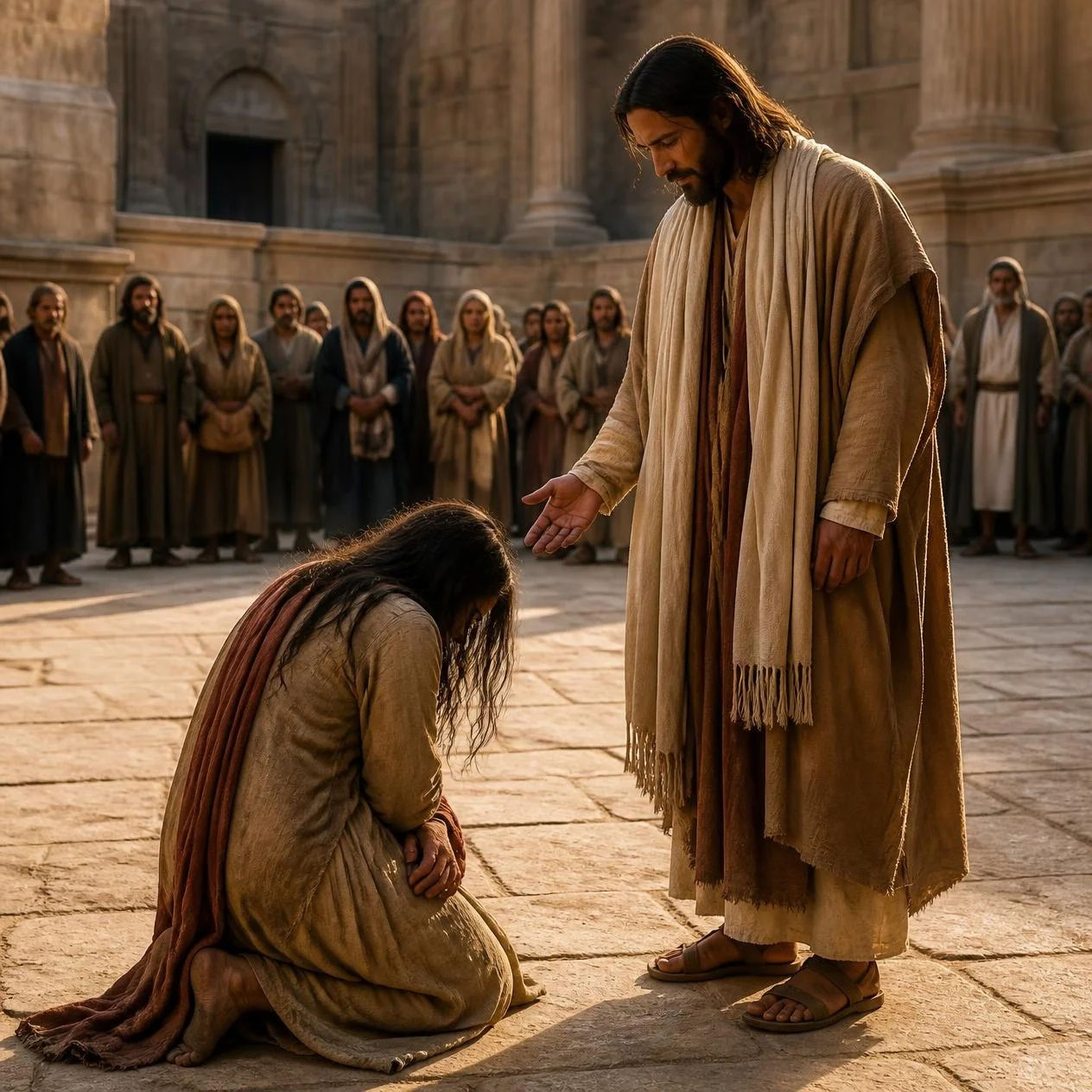
As the first rays of dawn crested the hills, the temple courts quickly filled with people. (John 8:1–2) “Jesus went unto the mount of Olives. Early in the morning he came again into the temple, and all the people came unto him; and he sat down, and taught them.”
His voice carried effortlessly through the colonnades, drawing listeners from every direction. The air was thick with a murmur of curious questions, the soft rustle of robes, and the occasional cough. He spoke with the quiet authority of one who had no need to raise his voice to command attention.
Suddenly, the assembled crowd parted.
A woman was forced forward—barefoot, disheveled, her gaze locked on the flagstones as if she might slip through them. The scribes and Pharisees flanked her like an impassable wall. (John 8:3–5) “And the scribes and Pharisees brought unto him a woman taken in adultery; and when they had set her in the midst, They say unto him, Master, this woman was taken in adultery, in the very act. Now Moses in the law commanded us, that such should be stoned: but what sayest thou?”
The question hung in the air like a blade. To demand her stoning was to endorse Roman execution rights, which Israel no longer legally held. To dismiss the charges was to discard the Law of Moses entirely. (John 8:6) “This they said, tempting him, that they might have to accuse him. But Jesus stooped down, and with his finger wrote on the ground, as though he heard them not.“
Jesus remained silent.
Etched solely in the dust of the ancient temple floor, his message remained an enigma. The scribes pressed forward, their voices sharpening with mounting impatience.
(John 8:7) “So when they continued asking him, he lifted up himself, and said unto them, He that is without sin among you, let him first cast a stone at her.”
His words were quiet, needing no volume to carry their weight.
(John 8:8) “And again he stooped down, and wrote on the ground.”
The silence that followed was far from empty—it was heavy and resonant. It was laden with memory and the quiet weight of the private burdens each man carried within his own chest. (John 8:9) “And they which stood by, when they heard it, were moved with conscience, and began to depart one by one, first of all the elders, and last of all the young men.”
Step by step, the elder led the way, his sandals scraping rhythmically against the stone. One by one, the others followed in a solemn procession. The courtyard emptied like a receding tide, leaving behind only a silent pair.
(John 8:10) “When Jesus had lifted up himself, and saw them, he said unto the woman, Where are now thine accusers? hath no one condemned thee?”
She looked up. For the very first time, her eyes met his—and they were entirely devoid of judgment.
(John 8:11) “She said, No one, Lord. And Jesus said unto her, Neither do I condemn thee: go thy way, and sin no more.”
She turned and walked out of the temple courts, left completely alone. The dust where Jesus had traced his mysterious message was already settling, sealing forever the secret of the words he had written.

Leave a Reply