
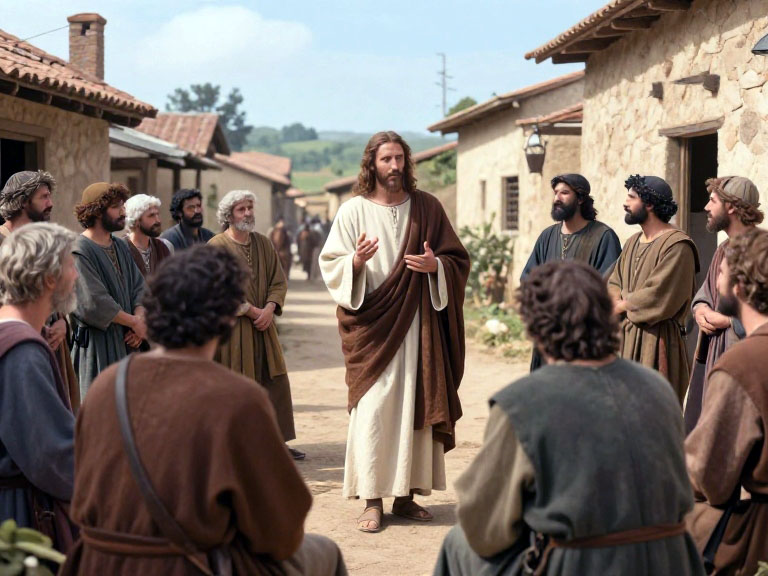
Who was Jesus of Nazareth? Was He merely a wise teacher, a revered prophet, or a radical political revolutionary? Or was He something entirely unprecedented—God incarnate, walking the dusty roads of Galilee in human form?
This question is not new; it was asked even during his own lifetime. The religious leaders of Israel looked at Him and asked, “Who is this, that even the winds and the sea obey him?” (Mark 4:41). Later, the centurion at the cross declared, “Truly this man was the Son of God” (Mark 15:39). Finally, after touching the wounds in his risen Lord’s hands, Thomas fell to his knees and confessed, “My Lord and my God” (John 20:28).
We do not live in the first century. We never walked dusty roads by His side, watched Him share a meal by the Sea of Galilee, or felt the earth tremble at the sound of His voice. So how can we truly know? How can anyone sitting in a modern living room today find certainty that the carpenter from Nazareth was indeed God in human form?
The conclusion is clear: the evidence is layered, cumulative, and overwhelming. It is found in his remarkable claims, his deliberate actions, his profound sacrifices, his unprecedented triumphs, and the unwavering conviction of his witnesses, who were willing to die for what they knew to be true.
What Jesus Claimed
Jesus did not whisper his divinity, nor did he conceal it within complex riddles meant only for the elite. Instead, he declared it openly, consistently, and with an unwavering authority that left his critics speechless:
John 8:58
“Verily, verily, I say unto you, Before Abraham was, I am.”
He did not say, “Before Abraham was, I was.” Instead, he declared, “I am” — employing the precise phrasing God used to reveal Himself to Moses at the burning bush:
Exodus 3:14
“And God said unto Moses, I AM THAT I AM: and he said, Say this to the children of Israel, I AM hath sent me unto you.”
The Jewish audience grasped the profound meaning behind the words. The scripture captures their instant reaction:
John 8:59
“And they took up stones to cast at him: but Jesus hid himself, and went out of the temple.”
They did not interpret his words as mere poetry. Instead, they recognized a direct claim to eternal divinity, and it was this profound assertion that drove them to seek his life.
John 10:30-33
“I and my Father are one. … Then the Jews took up stones again to stone him. Jesus answered them, Many good works have I shewed you from my Father; for which of those works do ye stone me? The Jews answered him, saying, For a good work we stone thee not; but for blasphemy; and because that thou, being a man, makest thyself God.”
John 1:1-3
“In the beginning was the Word, and the Word was with God, and the Word was God. The same was in the beginning with God. All things were made by him; and without him was not any thing made that was made.”
John 1:14
“And the Word was made flesh, and dwelt among us, (and we beheld his glory, the glory as of the only begotten of the Father,) full of grace and truth.”
Colossians 2:9
“For in him dwelleth all the fulness of the Godhead bodily.”
1 Timothy 3:16
“And without controversy great is the mystery of godliness: God was manifest in the flesh, justified in the Spirit, seen of angels, preached unto the Gentiles, believed on in the world, received up into glory.”
Titus 2:13
“Looking for that blessed hope, and the glories appearing of the great God and our Saviour Jesus Christ.”
Hebrews 1:8
“But unto the Son he saith, Thy throne, O God, is for ever and ever: a sceptre of righteousness is the sceptre of thy kingdom.”
Philippians 2:5-8
“Let this mind be in you, which was also in Christ Jesus: Who, being in the form of God, thought it not robbery to be equal with God: But made himself of no reputation, and took upon him the form of a servant, and was made in the likeness of men: And being found in fashion as a man, he humbled himself, and became obedient unto death, even the death of the cross.”
He was not merely a mortal masquerading as the Almighty; He was God incarnate in human form. The entirety of the divine nature did not simply visit Him—it made its permanent home within Him, fully expressed in tangible flesh and blood.
What Jesus Did
Words are easy. Anyone can claim to be divine. But the true measure of a claim is the reality that backs it up. And what followed Jesus’ assertions was a succession of extraordinary deeds that transcended the power of any prophet, teacher, or political figure:
He possessed the authority to forgive sins—an act belonging to God alone:
Mark 2:5-7
“And when Jesus saw their faith, he saith unto the paralytic, Son, thy sins be forgiven thee. … But straightway certain of the scribes, which were sitting there, reasoned in their hearts, Why doth this man so speak as he doeth? he blasphemeth: who can forgive sins but God only?”
He raised the dead to life.
John 11:43-44
“And when he thus had spoken, he cried with a loud voice, Lazarus, come forth. And he that was dead came forth, bound hand and foot with graveclothes: and his face was bound about with a napkin. Jesus saith unto them, Loose him, and let him go.”
With a single word, He silenced the storm:
Mark 4:39
“And he arose, and rebuked the wind, and said unto the sea, Peace, be still. And the wind ceased, and there was a great calm.”
He proclaimed himself greater than the temple, greater than Solomon, greater than the law:
John 2:19
“And Jesus answered and said unto them, Destroy this temple, and in three days I will raise it up.”
Matthew 12:42
“For a greater than Solomon is here.”
Matthew 12:6
“But I say unto you, That a greater thing than the temple is here.”
No prophet ever did these things, nor did any mere teacher. No mortal man could forgive sins, raise the dead, command the winds, and declare himself greater than the temple of God. Only God could do what Jesus did—and He did.
His Crucifixion
His miracles proved His divinity, but the crucifixion proved His divinity was personal—it proved He is God for you.
On the sixth day of the first week of April, in the year we now reckon as 30 or 33 AD, God incarnate was nailed to a cross outside the ancient walls of Jerusalem. What transpired on that cross was no accident of history, nor was it a tragic miscalculation, nor the bitter end of a good man with a noble cause. Rather, it was the deliberate, planned, and eternal act of the one true God, offering Himself as the ultimate sacrifice so that the sins of every human being who has ever lived—and every soul yet to be born—might be fully forgiven.
Long before he began his journey to Calvary, his identity had already been revealed:
John 1:29
“The next day John seeth Jesus coming unto him, and saith, Behold the Lamb of God, which taketh away the sin of the world.”
Not the sin of a single nation, nor the failure of a few disciples. The sin of the world—spanning every border, every era, and every human heart.
Seven centuries before it came to pass, the prophet Isaiah recorded these words:
Isaiah 53:4-6
“Surely he hath borne our griefs, and carried our sorrows: yet we did esteem him stricken, smitten of God, and afflicted. But he was wounded for our transgressions, he was bruised for our iniquities: the chastisement of our peace was upon him; and with his stripes we are healed. All we like sheep have gone astray; we have turned every one to his own way; and the LORD hath laid on him the iniquity of us all.”
He was not punished for his own sins, for he was entirely without fault. Instead, he suffered for ours. The judgment that we rightfully deserved fell upon him, and the devastating wounds meant for us were willingly borne by him.
2 Corinthians 5:21
“For he hath made him to be sin for us, who knew no sin; that we might be made the righteousness of God in him.”
The blameless One bore the weight of every transgression ever committed. Why? So that we—stained by our own rebellion—might be clothed in His perfect righteousness. It was a complete and profound exchange: He stood in our place, that we might finally stand in His.
Romans 5:8
“But God commendeth his love toward us, in that, while we were yet sinners, Christ died for us.”
Not while we were repentant. Not while we were seeking Him. Not while we were good enough. While we were yet sinners. We were still in our sin, still turning away, still enemies—and yet, He died for us anyway.
Romans 3:23-25
“For all have sinned, and come short of the glory of God; Being justified freely by his grace through the redemption that is in Christ Jesus: Whom God hath set forth to be a propitiation through faith in his blood, to declare his righteousness for the remission of sins that are past, through the forbearance of God;”
Every person who has ever lived has sinned and fallen short of God’s standard. Yet, the remedy was never found in a moral reform program or a system of self-improvement. Instead, our salvation is rooted in a propitiation—a divine sacrifice that fully satisfied the justice of God—made freely available to all through faith in His blood.
Hebrews 9:26-28
“For then must he often have suffered since the world was made: but now once in the end hath he put away sin by the sacrifice of himself. And as it is appointed unto men to die once; and after this the judgment: So Christ was once offered to bear the sins of many; and unto them that look for him shall he the second time appear without sin unto salvation.”
Under the former covenant, animals had to be sacrificed year after year, repeating a cycle because the blood of bulls and goats could never truly take away sin. Yet Christ was offered once. A single sacrifice. One death. It was completely sufficient for all time, for all people, and for all sin. It never required repetition in the past, and it requires no repetition today. “It is finished.”
1 Peter 1:18-19
“Forasmuch as ye know that ye were not redeemed with corruptible things, as silver or gold, from your vain conversation received by tradition from your fathers; But with the precious blood of Christ, as of a lamb without blemish and without spot:”
Redemption was not purchased with silver or gold, nor earned through human striving. You were bought with a supreme price: the precious, unstained blood of the Lamb, the very life of God incarnate.
1 Peter 2:24
“Who his own self bare our sins in his own body on the tree, that we, being dead to sins, should live unto righteousness: by whose stripes ye were healed.”
He bore our sins—not as a vague metaphor or a spiritual abstraction. In His own body, upon the tree, the transgressions of humanity were laid upon Him. He carried them to the cross and perished beneath their crushing weight. Those very wounds—the agonizing marks of the scourge, the tearing of the nails, and the soldier’s spear piercing His side—are the precise grounds of your healing, the source of your ultimate freedom, and the reason you stand forever free from condemnation.
Galatians 3:13
“Christ hath redeemed us from the curse of the law, being made a curse for us: for it is written, Cursed is every one that hangeth on a tree.”
The law pronounced a curse upon all who failed to keep it, and every single person had fallen short. The weight of that judgment had to land somewhere, and it landed on Him. He bore the curse so that you would never have to. He hung upon the tree so that you would not perish in the fires of hell.
1 John 2:2
“And he is the propitiation for our sins: and not for ours only, but also for the sins of the whole world.”
It is not just for the believers of the first century. It is not just for the Jews, nor is it exclusively for the “good” people. It is for the whole world. Every single person. Every sin. Every failure. All of it—covered, handled, and finished.
Romans 4:25
“Who was delivered for our offences, and was raised again for our justification.”
He was delivered—handed over, surrendered, and sacrificed—for our transgressions. And he was raised—not merely as proof of his own innocence, but for our justification. His resurrection stands as the definitive legal declaration that the debt has been paid in full. The sin is eradicated. The final verdict is absolute: not guilty.
Colossians 1:19-20
“And, having made peace through the blood of his cross, thereby to reconcile all things unto himself; by him, whether things in earth, or things in heaven.”
The cross was far more than a mere rescue; it was a profound reconciliation. God and humanity, once divided by the impenetrable barrier of sin, were united once more. This divine restoration was not achieved through human striving, but through God reaching down. It was accomplished through His sacrifice, His suffering, and His ultimate act of peace forged in the blood of His own Son.
Luke 23:46
“And when Jesus had cried with a loud voice, he said, Father, into thy hands I commit my spirit: and having said thus, he gave up the ghost.”
He did not simply fade away or lose consciousness. He actively committed his spirit to his Father, surrendering it deliberately and voluntarily. He chose to die, proving that no one took his life from him:
John 10:17-18
“Therefore doth my Father love me, because I lay down my life, that I might take it again. No man taketh it from me, but I lay it down of myself. I have power to lay it down, and I have power to take it again. This commandment received I of my Father.”
He possessed the power to live, yet He chose to die. He had the strength to save himself, yet He chose to save you.
This is the sacrifice. This is the atonement. This is the reason you can stand before the holiest God in the universe and not be consumed. You do not stand because you are clean, but because He became the sacrifice. You do not stand because you are good enough, but because He was entirely sufficient in your place.
And what followed—the pivotal three days bridging the cross and the empty tomb—is what sealed the power of the sacrifice. For a sacrifice that remains in the grave is merely a tragedy, but a sacrifice that rises becomes an ultimate victory. And that is precisely what unfolded next.
Three Days in Death
Now we arrive at the pivotal moment that seals the case. This is the definitive event that transforms every claim, every miracle, and every spoken word into an unassailable reality.
Jesus was crucified, laid in a tomb, and remained dead for three days.
Yet death was not the end; rather, it marked the dawn of the greatest act in the history of the universe.
When Jesus breathed his last on the cross, his lifeless body was laid within the quiet walls of a tomb. Yet his spirit did not fade into nothingness. Instead, he descended into Hades—the ancient realm of the dead. Within the deep shadows of the grave, he accomplished a feat utterly unprecedented, one that would echo through eternity and could never be repeated.
He conquered death from the inside.
1 Peter 3:18-20
“For Christ also once suffered for sins, the just for the unjust, being once offered for sins; who verily was put to death in the flesh, but quickened by the Spirit: In which also he went and preached unto the spirits in prison; That formerly were disobedient, (when once the longsuffering of God waited in the days of Noah,) while the ship was preparing wherein few, that is, eight souls were saved by water.”
Ephesians 4:8-10
“Wherefore he saith, When he ascended up on high, he led captivity captive, and gave gifts unto men. (Now this, He ascended, what is it but that he also first descended into the lower parts of the earth? He that descended is the same also that ascended up far above all the heavens, that he might fill all things.)”
Psalm 16:10
“For thou wilt not leave my soul in hell; neither wilt thou suffer thine Holy One to see corruption.”
Acts 2:27
“For thou wilt not leave my soul in hell; neither wilt thou suffer thine Holy One to see corruption.”
He descended into the realm of death. He walked into the dark prison where every human soul had been held captive since Adam, and he smashed the gates wide open.
Psalm 24:7-10
“Lift up your heads, O ye gates; and be ye lift up, ye everlasting doors; and the King of glory shall come in. Who is this King of glory? The LORD strong and mighty, the LORD mighty in battle. Lift up your heads, O ye gates; even lift them up, ye everlasting doors; and the King of glory shall come in. Who is this King of glory? The LORD of hosts, he is the King of glory. (Selah.)”
The gates of Hades were not opened by permission. They were shattered by force. The Jesus did not ask to enter. He stormed in, trampling the gates beneath His feet and seizing the keys of death and hell.
Revelation 1:18
“I am he that liveth, and was dead; and, behold, I am alive for evermore, Amen; and have the keys of hell and of death.”
He took the keys of hell and the keys of death and he kept them. They are no longer in the grip of Satan, nor do they belong to the grave. They rest securely in the hand of the risen Christ. Death is locked, the tomb is sealed, and the sole keeper of the keys is the One who conquered death and rose again.
Hebrews 2:14-15
“Forasmuch then as the children are partakers of flesh and blood, he also himself likewise took part of the same; that through death he might destroy him that had the power of death, that is, the devil; And deliver them who through fear of death were all their lifetime subject to bondage.”
He shattered the dominion of death, liberating all who had languished in bondage for a lifetime, crippled by dread. Every soul long confined to the shadows of Hades since the dawn of time—the faithful who waited in the gloom for their redeemer—was finally released.
1 Corinthians 15:25-26
“For he must reign, till he hath put all enemies under his feet. Last of all cometh the end, when he shall have delivered the kingdom to God, even the Father, when he shall have destroyed all rule, and all authority, and power. For he must reign till he hath put all enemies under his feet.”
The final enemy to be destroyed is death, for God has placed everything under his feet.
This is not a metaphor. This is not a spiritual illustration. This is a historical event. A God incarnated died. A God descended into the realm of the dead. A God shattered its gates. A God seized the keys. And a God walked out of the tomb on the third day—alive, breathing, eating, speaking, and touching.
The Resurrection: Seen by Many
The resurrection was far from a private vision or a solitary dream in the dark. It was a public, physical, and multi-witness event, corroborated by hundreds of individuals in a matter of weeks.
1 Corinthians 15:3-8
“For I delivered unto you first of all that which I also received, how that Christ died for our sins according to the scriptures; And that he was buried, and that he rose again the third day according to the scriptures: And that he was seen of Cephas, then of the twelve: After that, he was seen of above five hundred brethren at once; of whom the greater part remain unto this present, but some are fallen asleep. After that, he was seen of James; then of all the apostles. And last of all he was seen of me, as of one born out of due time.”
Let that sink in: five hundred brethren at once. Not one. Not two. Not a small, isolated group of devoted followers who could easily be dismissed as conspirators. Five hundred individuals, gathered in a single place at the very same time, witnessed the risen Christ. Then, Paul adds a detail designed to arrest the attention of any skeptic: “of whom the greater part remain unto this present.”
Addressing the Corinthians, Paul points to a powerful reality: many of these witnesses are still alive. You can go and speak with them directly. Look them in the eye and ask, “Did you truly see him? Did he eat at your table? Did you touch his hands? Did he speak to your face?” Go. Ask them. Right now. They are still here.
This is not the voice of mythology; it is the deliberate testimony of a man who fully expects his audience to cross-reference his claims with living witnesses.
Luke 24:36-43
“And as they thus spake, Jesus himself stood in the midst of them, and saith unto them, Peace be unto you. But they were terrified and affrighted, and supposed that they had seen a spirit. And he said unto them, Why are ye troubled? and why think evil in your hearts? Behold my hands and my feet, that it is I myself: handle me, and see; for a spirit hath not flesh and bones, as ye see me have. And when he thus had spoken, he shewed them his hands and his feet. And while they yet believed not for joy, and wondered, he said unto them, Have ye here any meat? And they gave him a piece of a broiled fish, and of an honeycomb. And he took it, and did eat it before them.”
He did not appear as a phantom, nor did he drift through a wall to vanish into thin air. He stood solidly in the room, holding out His hands and showing His feet for them to see. He asked for something to eat and partook of a meal right before their eyes. Spirits do not eat. Hallucinations do not eat. Dreams do not eat. A living body does.
John 20:24-28
“Now Thomas (called didymus), one of the twelve, was not with them when Jesus came. … Then said he again unto them, Peace be unto you: as my Father hath sent me, even so send I you. And when he thus had spoken, he breathed on them, and saith unto them, Receive ye the Holy Ghost. … And after eight days again his disciples were within, and Thomas with them: then cometh Jesus, his doors being shut, and stood in the midst, and saith, Peace be unto you. Then saith he to Thomas, Reach hither thy hand, and thrust it into my side; and be not faithless, but believing. And Thomas answered and said unto him, My Lord and my God.”
Thomas—the doubter, the skeptic, the man who declared he would never believe unless he could touch the wounds—reached out his hand. He placed it into the side of Christ. Overwhelmed, he fell to his knees and whispered, “My Lord and my God.”
John 21:12-13
“When they were come ashore, they saw a fire of coals there, and fish set upon it; and bread. Jesus saith unto them, Come and dine. But none of the disciples dared to ask him, Who art thou? knowing that it was the Lord.”
He cooked breakfast for them, sat with them, and shared their meals. Over and over, across forty days and numerous appearances, the risen Christ ate, spoke, touched, and walked alongside his disciples.
Acts 1:3
“After his suffering, he shewed himself to them, and gave many evident proofs that he was alive, appearing unto them space of forty days, and speaking of the things pertaining to the kingdom of God.”
Over the course of forty days, numerous unmistakable proofs were revealed. Not just a single sighting, nor a couple. Instead, there were forty days of repeated, physical, and fully verifiable appearances.
No One Dies for a Lie
Now consider the argument that no amount of philosophical sophistication can dismantle.
The disciples did not merely claim to have witnessed the risen Christ; they died saying it..
Historical accounts indicate that Peter suffered crucifixion upside down in Rome, while Paul was beheaded in the same city. James, the son of Zebedee, met his end by execution at the hands of Herod Agrippa, and Andrew was crucified on an X-shaped cross. Thomas died by a spear, and Matthew perished in Ethiopia. Philip faced crucifixion, Bartholomew suffered the agony of being flayed alive, James the son of Alphaeus was beaten to death with a club, Simon the Zealot was sawn in two, and Thaddeus was executed with arrows.
Historically, of the original twelve apostles, all but one suffered martyrdom for proclaiming their eyewitness testimony of the resurrection of Jesus Christ.
Yet the circle of sacrifice extended far beyond the twelve apostles. Stephen was stoned for his faith. James, the brother of Jesus, was executed. Perpetua and Felicity faced the lions in the arena, while Polycarp was burned at the stake. From its very inception, the early church was comprised of steadfast believers who walked with resolute peace into persecution, refusing to renounce the name of Jesus.
Take a moment to ponder this critical question without rushing:
What could possibly compel every last one of them to die for a fabrication?
Should the resurrection be nothing more than a fabrication—whether the disciples stole the body, experienced mass hallucinations, or simply invented the tale—they would have known it was a lie. Having witnessed the execution, handled the body, and watched the tomb sealed, they were intimately aware of the reality. Knowing the truth of the deception, when Roman authorities demanded they recant under threat of death, basic self-preservation dictates they would have immediately complied.
Yet they did not recant. They died for it.
Human beings do not die for a falsehood. This is not a matter of theology; it is a fundamental psychological reality. Above all else, human nature is driven by self-preservation. We will lie to escape pain, turn on friends to evade death, and compromise nearly everything to keep breathing. The notion that a band of men would willingly endure a slow, agonizing, public execution rather than utter a simple denial defies reason—unless what they were dying for was true.
And it was not merely a handful of individuals. It was hundreds. It was thousands. It was an entire movement that swept across the Roman Empire in a matter of decades, fueled by believers who faced the arena, were burned alive, and endured crucifixion in public squares. Fabrications do not achieve this. A falsehood crumbles under pressure and collapses the moment the first person breaks. Yet the testimony of the resurrection did not fracture. It multiplied, it expanded, and ultimately, it transformed an empire.
2 Timothy 2:9
“But I am not ashamed: for I know whom I have believed, and am persuaded that he is able to keep that which I have committed unto him against that day.”
Acts 4:20
“But we cannot but speak the things which we have seen and heard.”
They could not stop. Not because they were foolish. Not because they were deluded. But because they had seen Him. They had touched Him. They had broken bread with Him. And the gravity of what they had witnessed far outweighed the value of their own lives.
The Weight of the Evidence
A man claimed to be God. He forgave sins, raised the dead, and calmed storms, boldly declaring himself greater than the temple. He was crucified, died, and was buried. Three days later, the tomb was empty and his body was gone. Then, over the span of forty days, he appeared to hundreds. He ate with them, allowed them to touch him, spoke to them, and commissioned them before ascending into heaven.
And then his witnesses ventured across the known world, proclaiming with unwavering conviction, “He is alive. He is God. He rose.” They carried this truth to the ends of the earth, proclaiming it with their final breaths.
That is not a story. That is not a legend. That is not a myth that grew over centuries. That is a historical event with a chain of evidence that is, in the words of the historian who studied it, “the best-attested event in ancient history.”
Leave a Reply