
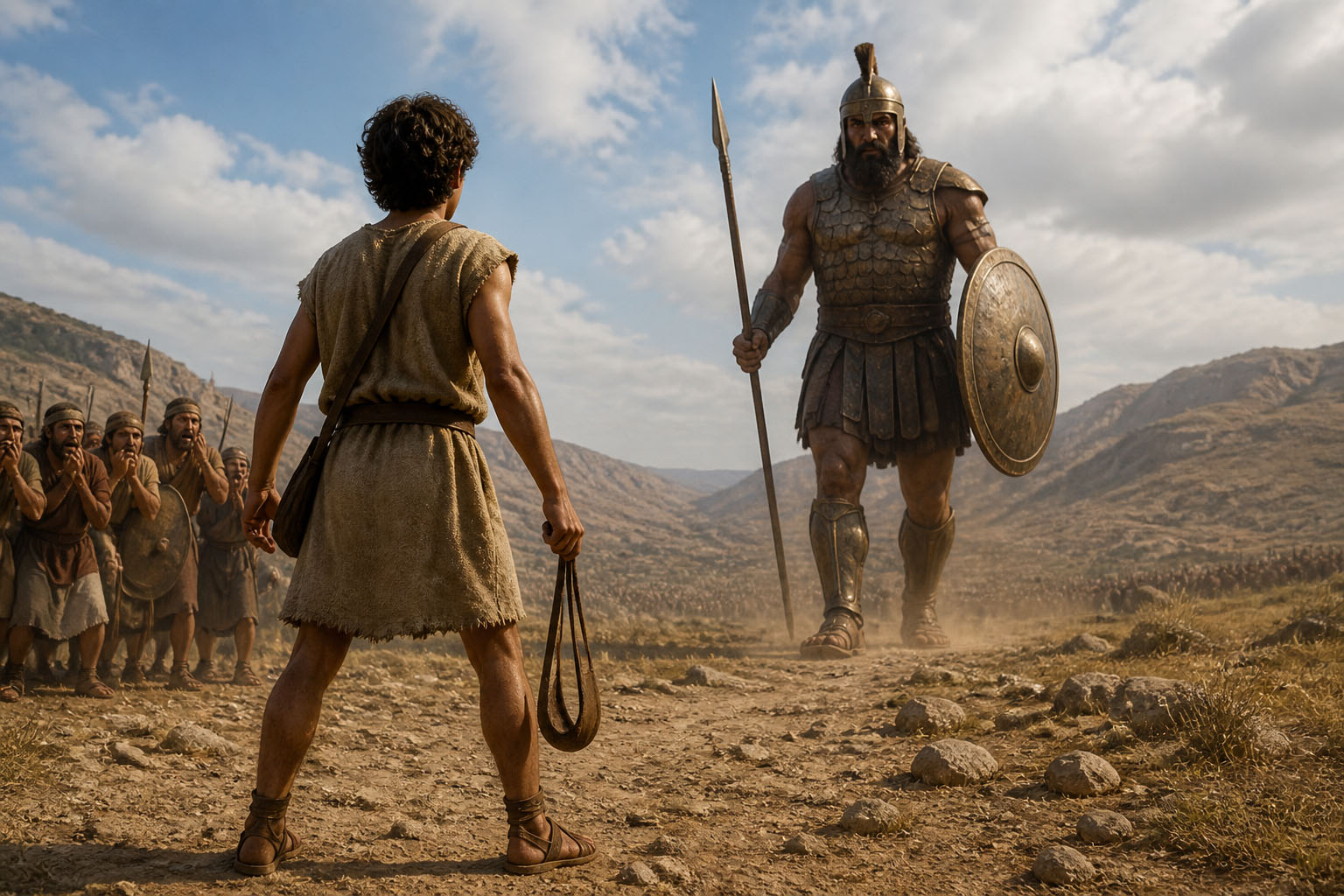
In the valley of Elah, the armies of Israel stood paralyzed by fear. For forty consecutive days, a towering giant emerged morning and evening to hurl his defiance, yet not a single soldier in the camp dared to answer his challenge.
To everyone’s absolute astonishment, the person who finally answered was the last one anyone would have expected.
The Shepard
David was the youngest of Jesse’s sons in Bethlehem. While his three eldest brothers marched off to war alongside King Saul, David remained at home, tending the family’s sheep.
1 Samuel 17:14-15
“And David was the youngest: and the three eldest followed Saul. But David went and returned from Saul to feed his father’s sheep at Bethlehem.”
Devoid of armor, stripped of titles, and nameless among the ranks of the camp, he was merely a shepherd boy wielding a simple sling. As he guided his flock through the dust of Bethlehem, his entire nation trembled in terror across the valley.
The Giant
The Philistine champion stood as a towering titan of bronze and terror, a relentless wall of scale armor and towering muscle that cast a long, intimidating shadow across the trembling valley.
1 Samuel 17:4
“And there went out a champion out of the camp of the Philistines, named Goliath, of Gath, whose height was six cubits and a span.”
Standing over nine feet tall and clad head to toe in bronze—his coat of mail alone weighing five thousand shekels (roughly 125 pounds)—he strode between the two armies like an impenetrable fortress, hurling daily taunts at the God of Israel.
1 Samuel 17:5
“And he had an helmet of brass upon his head, and he was armed with a coat of mail; and the weight of the coat was five thousand shekels of brass.”
A vast legion of battle-hardened warriors, veterans of a thousand brutal campaigns who had conquered empires and stared down legendary beasts, now stood frozen in absolute terror before him, their once-unshakable courage completely shattered by the sheer, apocalyptic malice radiating from his towering form.
God’s Choice
Yet prior to this confrontation, the Almighty had already made His choice. When the prophet Samuel arrived to consecrate the future king from the lineage of Jesse, he beheld the towering, impressive eldest son, Eliab, and instantly presumed he was the one. The Lord corrected him, declaring:
1 Samuel 16:7
“But the LORD said unto Samuel, Look not on his countenance, or on the height of his stature; because I have refused him: for the LORD seeth not as man seeth; for man looketh on the outward appearance, but the LORD looketh on the heart.”
God chose neither the biggest nor the most impressive. Instead, He selected the shepherd boy whom no one had even bothered to invite to the gathering. From that day forward, the Spirit of the Lord rested upon David.
The Sling and the Stone
Armed with only a shepherd’s staff, a sling, and five smooth stones collected from a nearby brook, David stepped into the valley without sword, spear, or shield. He advanced toward the towering nine-foot giant and proclaimed:
1 Samuel 17:45
“Then said David to the Philistine, Thou comest to me with a sword, and with a spear, and with a shield: but I come to thee in the name of the LORD of hosts, the God of the armies of Israel, whom thou hast defied.”
1 Samuel 17:47
“And all this assembly shall know that the LORD saveth not with sword and spear: for the battle is the LORD’S, and he will give you into our hands.”
With just a single stone cast from a humble sling, the giant’s arrogant laughter was cut short. A solitary, precise strike found its mark, shattering invincibility in an instant and sending the towering titan crashing to the earth.
From Nobody to King of the Promised Land
To the cheering crowds on the valley floor, it was merely the shocking upset of a shepherd boy felling a bronze-clad giant with a single stone. But behind the dust and the roar of the battlefield, God was orchestrating something far greater: the quiet, undeniable coronation of Israel’s true king.
David was first anointed king over Judah and subsequently over all Israel. He successfully captured the fortress of Zion from the Jebusites—defying their taunts that “David cannot come in here”—and established it as his royal capital:
2 Samuel 5:7
“Nevertheless David took the strong hold of Zion: the same is the city of David.”
2 Samuel 5:5
“In Hebron he reigned over Judah seven years and six months: and in Jerusalem he reigned thirty and three years over all Israel and Judah.”
Through unifying the fractured tribes, establishing the capital, and laying the groundwork for the nation promised to Abraham, Isaac, and Jacob, he fulfilled the Lord’s plan. God then sealed this monumental achievement with an eternal covenant:
2 Samuel 7:12-13
“And when thy days be fulfilled, and thou shalt sleep with thy fathers, I will set up thy seed after thee, which shall proceed out of thy bowels, and I will establish his kingdom. He shall build an house for my name, and I will stablish the throne of his kingdom for ever.”
The humble shepherd boy from Bethlehem—the youngest, the overlooked, the nobody—rose to become the king who established God’s people in their Promised Land, securing a divine promise that his throne would endure forever. Through this very lineage, God would ultimately send the King of kings.
The entire narrative is captured in a single sentence: God looked past every superficial standard and chose the nobody, because the nobody was full of faith.
Leave a Reply