
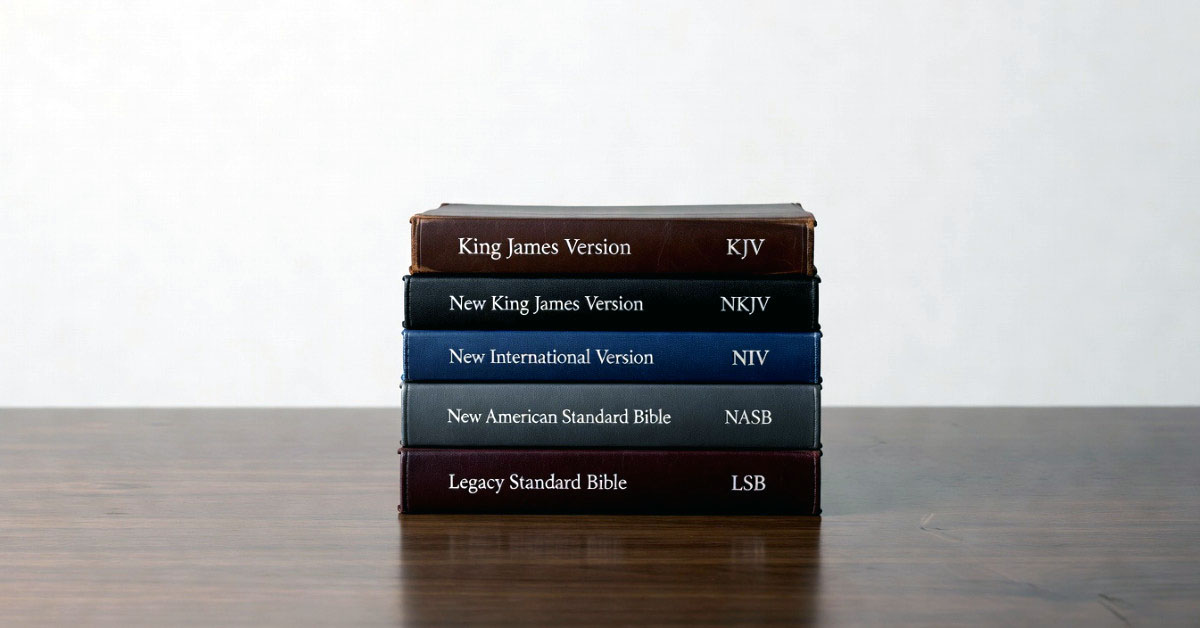
Risks in “Thought-for-Thought” Translations
Most Christians never think to question their Bible. They simply open it, read it, and place their trust in its pages—a trust that is largely well-placed. Yet, a structural issue remains hidden in plain sight within the creation of the most popular English Bibles. Understanding this dynamic is crucial, as it can quietly shape your beliefs without you ever realizing a translator made a choice.
The New International Version (NIV) stands as the world’s best-selling English Bible, yet it is also the translation most frequently cited by critics for phrasing that makes Jesus appear to contradict himself.
In John 7:8, the King James Version and the original 1984 NIV read:
“I am not going up yet to this feast.”
The 2011 NIV revision removed the word “yet”:
“I am not going up to this feast.”
In John 7:10, Jesus attends the feast after initially declining, leading the 2011 NIV to appear as though He contradicted Himself—an issue absent in the 1984 NIV and the KJV. This discrepancy arises because the earliest Greek manuscripts omit the word oupō (“yet”), which only surfaces in later texts. While the 2011 translation committee made a defensible choice by prioritizing these older manuscripts, the oversight leaves modern readers without a footnote explaining the shift. Consequently, Jesus appears inconsistent on the page, stripped of the crucial context needed to resolve the textual tension.
This is the fundamental hazard of thought-for-thought translation, extending far beyond a single verse.
What is “Optimal Equivalence”
The NIV describes its approach as “optimal equivalence,” striking a careful balance between word-for-word accuracy and thought-for-thought clarity. Practically speaking, this means the translation committee evaluates each verse individually, deciding whether a literal or dynamic rendering is best. The reader remains entirely unaware of this internal debate, encountering only the final result.
This introduces several tangible risks:
Unseen interpretive decisions. Romans 1:17 features the grammatically ambiguous Greek phrase dikaiosynē theou. This expression can be translated as either the “righteousness of God,” referring to God’s inherent attribute, or the “righteousness from God,” denoting a gift bestowed upon humanity. While the NIV opts for “from God,” the ESV and NASB retain “of God.” Consequently, readers of the NIV remain unaware that an interpretive dilemma even exists, receiving a single definitive answer disguised as the unambiguous voice of the text.
Selective rendering of identical terms. The Greek word sarx (“flesh”) is translated as “sinful nature” in passages like Romans 8:8 to align with a specific theological framework, while remaining “flesh” elsewhere. Similarly, the Greek term erga (“works”) is preserved in negative contexts (such as Romans 3:27) but translated using varied synonyms in positive ones. This creates a subtle bias: a single original word takes on different meanings based on the desired theological direction. Because the audience reads English rather than Greek, this inconsistency remains entirely hidden from the reader.
Lack of transparency. “Optimal equivalence” is a vague label. There is no published formula that specifies when to translate literally versus dynamically. Instead, the committee makes these decisions on a verse-by-verse basis, leaving the reader with no way to audit their choices.
Loss of Original Tension. Biblical Hebrew and Greek frequently feature deliberate ambiguity, poetic parallelism, and theological tension. Thought-for-thought translations tend to iron these nuances out. While this approach enhances readability, it often sacrifices theological substance for stylistic smoothness.
Revision drift. Because committees hold interpretive latitude, successive revisions inevitably pull renderings in fresh directions. The gender-inclusive updates in the 2011 NIV offer the most prominent illustration, yet this dynamic affects any theological vocabulary. Strictly literal translations operate under a natural constraint—the original terminology strictly limits editorial freedom. Hybrid versions enjoy no such boundaries.
The NKJV Has the Same Problem
The New King James Version (NKJV) is frequently promoted as a conservative, literal alternative to the NIV, and it certainly is more word-for-word than its counterpart. Yet, despite its fidelity, it remains the product of a committee making interpretive choices, presenting those decisions as the definitive meaning of the text. When the NKJV translates a Greek term in a specific way, it offers no footnote to suggest alternative interpretations like “this could also mean X.” Instead, the reader is handed a finalized conclusion rather than an invitation to explore the text.
How the LSB Fixes Almost All of This
The Legacy Standard Bible (LSB), developed under the guidance of John MacArthur and the faculty of The Master’s Seminary, was specifically crafted to resolve these structural shortcomings.
Consistent vocabulary. The same Greek or Hebrew term is translated with the exact same English word every time. Doulos remains “slave” throughout—never fluctuating between “servant,” “bondservant,” and “slave.” Similarly, sarx is consistently rendered as “flesh” rather than shifting between “sinful nature” and “flesh” depending on the verse. This completely eradicates the issue of selective translation at its source.
A single transparent rule. The methodology is straightforward: be entirely literal. There is no subjective call for “optimal equivalence.” Because the rule is mechanical and consistent, readers can easily audit every rendering against the original source.
Preserved Ambiguity. Verb tenses, word order, and syntactic structures remain untouched. Instead of being smoothed away, the original tensions stay visible, inviting readers to engage directly with them.
Over 14,000 translation footnotes. This indispensable element forms the foundation of the LSB reference editions, which feature detailed notes categorized into three distinct types:
- More literal renderings — When the main text employs a slightly freer English idiom, the footnote provides a more direct, word-for-word translation.
- Variant manuscript readings — When the source text contains a variant, the corresponding footnote displays the alternate reading.
- Alternate translations and wordplays — when a double meaning from the original text cannot be fully captured in the main body, the footnote provides the alternative rendering.
In addition, the Tyndale Center at The Master’s Seminary has published a comprehensive set of translation notes spanning all 66 books, which shed light on the rationale behind specific word choices and phrases.
The LSB operates on a dual-layered approach: the footnotes reveal what alternative paths were available, while the translation notes explain why the current path was chosen. This creates a fundamentally different dynamic between the reader and the text than what is offered by translations like the NIV and even the NKJV.
Why Transparency Is the Point
Every translation, no matter how mechanical or literal, requires interpretive decisions regarding word choice, syntax, ambiguity, and idiom. It is impossible to produce an English Bible without actively assigning meaning. This is not a flaw; it is simply the unavoidable reality of the work.
The sole distinguishing factor is whether those selections are visible or invisible.
Without visibility into discarded alternatives, evaluating the superiority of a final translation is impossible. Users are left with a binary choice: blindly trust the translator with zero ability to audit, or dismiss the output entirely, rendering it useless. Transparency introduces a powerful third option: critical evaluation. By exposing the original terminology and the alternative options, transparency empowers you to make an informed, independent judgment.
This mirrors the fundamental math teacher’s rule: always show your work. You might not agree with the final result, but displaying the steps allows anyone to verify whether the logic holds up.
Without transparency, you are no longer reading a translation. Instead, you are consuming someone else’s conclusion about a text, disguised as the translation itself. In more egregious cases, you are simply reading a third party’s subjective interpretation, and that’s what can be dangerous.
Your Bible Could Mislead You
This is no mere theoretical problem. The NIV 2011 translation of John 7:8 portrays Jesus as contradicting Himself. An unsuspecting reader—one who fails to cross-reference other versions or examine the original Greek—is left with the distinct impression that Scripture contains an internal contradiction. Such an error is far from trivial, as it directly undermines confidence in the reliability of the Bible itself.
And that is just a single verse. Multiply that across 31,000 verses, where every single line represents a hidden fork in the road where translators chose one meaning over another while keeping that process invisible to the reader. The result is a text that, in the aggregate, is not a neutral transmission, but rather a collection of thousands of small interpretive choices silently dressed up as the direct Word of God.
The Bottom Line
The ideal Bible for readers who value precision and verifiable accuracy is a word-for-word translation equipped with footnotes detailing alternative renderings. Currently, the LSB stands out as the translation that best fulfills this standard. While no translation is entirely without flaws, the LSB sets itself apart from the NIV, NKJV, ESV, and NASB in the most crucial way: it transparently indicates translation decisions and presents the alternative options.
That is not merely a small discrepancy; it is the fundamental chasm between experiencing the raw, unadulterated source material first hand and settling for someone else’s curated, second-hand interpretation of it.
Related Reading: Why I Chose the LSB Bible
Below is the complete transcript of the conversation that inspired this blog post, detailing the step-by-step evolution of thought with AI. You will notice moments where the AI relied on assumptions and bias, and how, when prompted to apply strict logic, it ultimately arrived at these insights. I am the “User” and AI is the “Assistant”.
AI Transcript
User: What NIV Bible was known for making it sound like Jesus lied?
Assistant: The 2011 revision of the New International Version (NIV) of the Bible is the version most frequently cited by critics as making it sound like Jesus lied, specifically regarding John 7:8.
In the King James Version (KJV) and the original 1984 NIV, Jesus says, “I am not going up yet to this feast,” implying he will go later. The 2011 NIV removed the word “yet,” rendering Jesus’ statement as “I am not going up to this feast,” which critics argue contradicts his subsequent appearance at the feast in John 7:10.
This translation change was made because the Greek word oupō (translated as “yet” in older versions) was found in later manuscripts but absent from the earliest and most reliable Greek manuscripts. While the 1984 NIV included “yet” to harmonize the text with the KJV tradition, the 2011 revision adhered strictly to the earliest available texts, omitting the word entirely.
User: Isn’t NIV thought-for-thought translation?
Assistant: Yes, the NIV is commonly categorized as a thought-for-thought (dynamic equivalence) translation, but with an important nuance: the NIV translators themselves describe their method as a balance between word-for-word and thought-for-thought — what they call “optimal equivalence.”
In practice, the NIV leans toward dynamic equivalence more than a strictly literal version like the ESV or NASB, but it’s less free than something like the NLT or The Message. So you’ll see it labeled “thought-for-thought” in most comparison charts, but it’s more accurately a mediating translation that shifts between literal and dynamic rendering depending on the passage.
This is relevant to the John 7:8 point from earlier — because the NIV prioritizes conveying the meaning it judges most likely from the original, translators make interpretive choices (like dropping “yet”) that a more literal translation would preserve or footnote.
User: What risks do you see with the NIV picking and choosing when to be thought-for-thought and when to be word-for-word?
Assistant: The core risks critics identify:
1. Invisible interpretive choices. When the NIV goes thought-for-thought, it makes an exegetical decision the reader never sees. A classic example is Romans 1:17 — the Greek dikaiosynē theou is ambiguous between “righteousness of God” and “righteousness from God.” The NIV picks “from God,” which closes off an alternative reading that other versions (ESV, NASB) preserve. The reader gets the translators’ interpretation presented as the text.
2. Doctrinal slippage through selective rendering. Critics (especially from the Church of Christ and conservative Reformed camps) argue the NIV renders the same Greek word differently depending on which theological direction serves. The most-cited example is sarx (“flesh”): rendered “sinful nature” in passages like Romans 8:8 where it fits a Calvinistic framework, but left as “flesh” elsewhere. Similarly, erga (“works”) is rendered “works” in negative contexts (Romans 3:27) but shifted to synonyms in positive ones, subtly pushing a faith-over-works reading.
3. No transparent rule for when to be free vs. literal. “Optimal equivalence” is criticized as a vague label that gives the committee discretion on a verse-by-verse basis. The reader has no way to know whether a given rendering is the most literal option or a dynamic one — and therefore no way to audit the choice.
4. Loss of the original’s ambiguity and tension. Biblical Hebrew and Greek often carry deliberate ambiguity, poetic parallelism, or theological tension. A thought-for-thought rendering smooths these away. As one scholar put it, “the reality of dynamic equivalence may turn out to be more dynamics than equivalence” — a more readable translation can sacrifice substance to style.
5. It becomes a commentary wearing the clothes of a translation. If the translation has already resolved interpretive questions, it crosses the line from “translation” to “translation + commentary.” The reader loses the ability to do their own exegesis against the raw text.
6. Revision risk compounds. Because the committee has interpretive latitude, each revision can shift renderings in new doctrinal directions (the 2011 gender-inclusive changes being the most visible example, but the principle applies to any theological term). A strictly literal version has a built-in check — the original words constrain what you can do. A hybrid version doesn’t.
The NIV’s defenders (including D. A. Carson) push back that all translation requires interpretation and that the NIV’s approach is moderate and well-documented. But the structural risk remains: the more latitude the committee has, the more the output reflects committee consensus rather than the text itself.
User: Does the LSB correct these issues stated above?
Assistant: The Legacy Standard Bible (LSB) addresses most of those issues by design, but not all of them.
What it does correct:
- Consistent vocabulary. The LSB’s core rule is that the same Greek/Hebrew word gets the same English word every time. This directly kills problem #2 — you can’t quietly render sarx as “sinful nature” in one verse and “flesh” in another. Doulos is “slave” throughout, not a rotating cast of “servant,” “bondservant,” and “slave.”
- No discretionary latitude. There’s no “optimal equivalence” judgment call. The method is simply: be literal. This addresses #3 and #5 — the reader can audit every rendering against the original because the rule is transparent and mechanical.
- Preserved ambiguity. By keeping verb tenses, word order, and syntactic structure intact, the original’s tensions and ambiguities remain visible for the reader to wrestle with rather than being smoothed away. This addresses #4.
- Reduced revision drift. Because the constraint is “match the original words,” each future revision has far less room to shift in new doctrinal directions. This partially addresses #6.
What it doesn’t fully solve:
- It’s still a committee with a theological center of gravity. The LSB was overseen by John MacArthur and Master’s Seminary faculty. The decision to render YHWH as “Yahweh” (6,800+ times) instead of “the LORD” is itself an interpretive choice — it foregrounds a particular reading of Exodus 3:14–15. The consistent “slave” rendering, while linguistically defensible, also carries a theological emphasis. So #5 (commentary in translation’s clothes) isn’t eliminated, just made more visible and more consistent.
- Literal ≠ neutral. A word-for-word translation still requires choosing which English word corresponds to a given Greek/Hebrew word, and that choice is never purely mechanical. The LSB makes those choices more consistently, but the reader is still getting a reading, not the raw text.
- Readability cost is real. The LSB reads noticeably stiffer than the NIV (roughly grade 10 vs. grade 7.8). For someone reading through for the first time, that friction can obscure meaning in ways that aren’t “interpretive” but are still a barrier.
Bottom line: The LSB structurally eliminates the NIV’s biggest vulnerability — invisible, inconsistent, verse-by-verse interpretive discretion — by replacing it with a single transparent rule. What remains is the smaller, inescapable problem that any translation is a choice, and the LSB’s choices are made from a particular (conservative Reformed) vantage point.
User: Isn’t it true the LSB uses footnotes to give the reader more context on translation, often showing the options a translation had and how it might be translated a few different ways?
Assistant: Yes, that’s correct. The LSB reference editions include over 14,000 translation footnotes that do exactly that. The foreword describes them in three categories:
- More literal renderings — when the main text uses a slightly freer English idiom for readability, the footnote gives the tighter word-for-word option.
- Variant manuscript readings — where the underlying Hebrew or Greek has a textual variant, the footnote shows the alternate reading.
- Alternate translations / wordplays — where a play on words or double meaning in the original can’t be captured in the main text, the footnote offers the other possible rendering.
The foreword states the purpose explicitly: “These notations have been used specifically to assist the reader in comprehending the terms used by the original author.” Italics within the footnotes mark the alternate reading, so you can see at a glance what the other option was.
On top of that, the Tyndale Center at Master’s Seminary has been releasing a separate, more extensive set of translation notes (covering all 66 books) that explain why specific words and phrases were rendered the way they were — essentially a running commentary on the translation decisions themselves.
So the LSB handles this in two layers: the in-text footnotes give you the “what the other option was,” and the separate translation notes give you the “why we chose this one.” It’s a more transparent setup than the NIV, where those choices are simply invisible.
User: How does that solve the issues you stated that it didn’t solve before?
Assistant: Honestly, they don’t fully solve them. They mitigate the first two and ignore the third:
“Committee with a theological center of gravity” — The footnotes make the choices visible rather than invisible, which is a real improvement. But the main text still reflects the committee’s judgment. A reader who doesn’t consult the footnotes (and most don’t) gets the same “commentary in translation’s clothes” problem, just one with a paper trail. The footnotes shift the burden of judgment onto the reader, but they don’t remove the committee’s hand from the main text.
“Literal ≠ neutral” — The footnotes partially address this by showing the range of options, so a careful reader can see that “slave” wasn’t the only defensible choice and can weigh the alternatives. But the main text still picks one, and that pick is made from a particular vantage point. Transparency is not neutrality — you can show me every option and still steer me with which one you put in the text.
“Readability cost” — The footnotes do nothing here. The main text still reads at roughly a grade 10 level. If anything, the density of footnotes adds to the friction for a first-time reader rather than reducing it.
So the fair summary is: the footnotes convert the LSB’s residual problems from silent to auditable. That’s a meaningful structural improvement over the NIV, where the choices are genuinely invisible. But “auditable” and “solved” are different things. The reader still has to do the work of cross-referencing, and the main text still carries the committee’s theological fingerprint.
User: Point 1 you made assumptions about most not reading the footnotes. Second point you sound biased saying “you can show me every option and still steer me with which one you put in text.” If someone was trying to steer you they wouldn’t show you alternative meanings. The way NIV and NKJV pick the meanings and translations for you without notifying you it could mean something else. Are you being biased from other views rather than being logical? Try being more logical.
Assistant: You’re right on both counts. Let me correct.
On #1: I made an unsupported claim about reading behavior. I don’t actually know what percentage of LSB readers consult the footnotes, and I shouldn’t have inserted that as if it were established fact. The fair version of the point is: the footnotes make the choices available, but they don’t force the reader to engage with them. That’s a real structural feature, not a criticism of the reader.
On #2: You’ve identified a real logical flaw in my argument. “Transparency is not neutrality” is technically true but rhetorically misleading. The actual comparison is:
- NIV/NKJV approach: Pick a meaning, present it as the meaning, no indication a choice was made. The reader cannot even know a question exists.
- LSB approach: Pick a meaning for the main text, and show you the alternatives and the original terms.
The second approach is not “still steering” in any meaningful sense compared to the first. If anything, the NIV’s approach is the one that actually steers, because it removes the reader’s ability to even see that a decision point existed. My framing treated them as roughly equivalent on the steering axis, which isn’t logical. Showing someone the alternatives is the opposite of the steering mechanism — it’s the thing that enables the reader to resist being steered.
The only residual point I’d keep, and it’s a small one: the main text still presents one option as primary. But that’s true of every translation, and it’s a far cry from the NIV’s approach of hiding the question entirely. I overstated it.
User: On this point: “The only residual point I’d keep, and it’s a small one: the main text still presents one option as primary. But that’s true of every translation, and it’s a far cry from the NIV’s approach of hiding the question entirely. I overstated it.” Wouldn’t it be hard to complete the Bible without trying to pick its meaning?
Assistant: No. It’s not just hard — it’s impossible. Even the most mechanical translation requires interpretive decisions at every level:
- Word selection. Greek agape can be “love,” “charity,” or “affection” depending on context. Even a “literal” translator has to pick.
- Syntax. Greek and Hebrew sentence structures don’t map one-to-one onto English. Word order, clause boundaries, and implied subjects all require judgment.
- Ambiguity. The original texts are genuinely ambiguous in places (Romans 1:17, John 7:8, the sarx passages). The text itself doesn’t resolve the question — the translator does.
- Idioms. Hebrew and Greek idioms have no direct English equivalent. “Wash your feet” is literal; “wash your hands of it” requires a dynamic choice.
So the real question was never whether a translation picks a meaning. It’s whether it makes that pick visible (LSB footnotes) or invisible (NIV). Every translation is a set of decisions; the only variable is transparency.
User: Logically would you want transparency when reading a translation so you could decide if the translator might have been wrong?
Assistant: Yes. The logic is straightforward:
If you cannot see what options existed, you cannot evaluate whether the chosen one was the best one. You’re forced to either:
- Accept it as fact — which means you’re trusting the translator’s judgment completely, with no ability to audit it.
- Distrust it entirely — which means you can’t use the translation at all.
Transparency gives you a third option: evaluate it. You see the original term, you see the alternatives, and you can form your own judgment about which rendering fits the context best. That’s the same principle as showing your work in math — you don’t have to agree with the answer, but you can check whether the reasoning was sound.
Without transparency, you’re not reading a translation. You’re reading someone’s conclusion about a translation, presented as if it were the translation itself.
[End transcript]
Leave a Reply