
What Jesus Actually Said About His Return
To understand what Jesus taught about his return, go straight to his own words. Bypass study Bible notes, dispensational systems, and nineteenth-century theological frameworks, and look directly at what he said.
In the Olivet Discourse—the single most detailed prophetic teaching Jesus ever delivered—He describes precisely one event: one coming, one gathering, and one judgment, never two.
Matthew 24:29–31
“Immediately after the tribulation of those days shall the sun be darkened, and the moon shall not give her light, and the stars shall fall from heaven, and the powers of the heavens shall be shaken: And then shall appear the sign of the Son of man in heaven: and then shall all the tribes of the earth mourn, and they shall see the Son of man coming in the clouds of heaven with power and great glory. And he shall send his angels with a great sound of a trumpet, and they shall gather together his elect from the four winds, from one end of heaven to the other.”
Read that again. The sequence is explicit:
- The tribulation of those days
- Cosmic signs
- The Son of Man appears in glory
- His elect are gathered
The gathering of the elect is an integral part of Christ’s visible and glorious return. It is neither a separate occurrence nor a clandestine event preceding it. Jesus never alludes to two distinct comings, nor does He hint at a secret removal of believers. Instead, He depicts a single, momentous event in which the world faces judgment and the faithful are gathered together at the very same time.
Matthew 24:27
“For as the lightning cometh out of the east, and shineth even unto the west; so shall also the coming of the Son of man be.”
A lightning flash is never a clandestine occurrence; a true rapture cannot unfold in secret beneath a bolt of lightning, for every eye witnesses its brilliance.
Matthew 26:64
“Hereafter shall ye see the Son of man sitting on the right hand of power, and coming in the clouds of heaven.”
One coming. In the clouds. Visible. Glorious.
The Gospels Align With One Event, Not Two
The pre-tribulation rapture relies on a theological sleight of hand: it divides Christ’s singular return into two distinct events—a hidden, secret rapture followed years later by a public, visible second coming. Yet, this two-stage framework is entirely absent from the Gospels.
John 14:3
“And if I go and prepare a place for you, I will come again, and receive you unto myself; that where I am, there ye may be also.”
Jesus employs the Greek term paralambanō, which translates to “receive” or “take to yourself.” He is returning once again in a single future advent to receive His followers to Himself. This exact verb is also utilized by Jesus in:
Matthew 24:40–41
“Then shall two be in the field; the one shall be taken, and the other left. Then shall two be grinding at the mill; the one shall be taken, and the other left.”
The exact same word conveys the meaning of being “received.” If John 14:3 clearly describes a rescue—”I will receive you unto myself, that where I am, there ye may be also”—then the word “taken” in Matthew 24:40 carries that identical positive connotation. The individual who is taken is welcomed by Christ, while the one left behind remains to face judgment.
This is not a secret event. It occurs openly at the visible return, after the tribulation of those days.
What 1 Thessalonians 4 Is Actually About
At this crucial juncture, proponents of the pre-tribulation rapture make their defining argument. They isolate 1 Thessalonians 4:15–17, classifying it as a distinct, chronologically prior occurrence—a covert extraction transpiring before the tribulation period begins. However, examining the passage within its proper context reveals a different picture:
1 Thessalonians 4:15–17
“For this we say unto you by the word of the Lord, that we which are alive and remain unto the coming of the Lord shall not prevent them which are asleep. For the Lord himself shall descend from heaven with a shout, with the voice of the archangel, and with the trump of God: and the dead in Christ shall rise first: Then we which are alive and remain shall be caught up together with them in the clouds, to meet the Lord in the air: and so shall we ever be with the Lord.”
Notice Paul’s specific wording: “unto the coming of the Lord.” He is not referring to a separate, covert event. Instead, he is describing what occurs at the coming of the Lord—the very same event Jesus outlined in Matthew 24. Paul is directly addressing a pastoral concern: “What will happen to believers who have already died? Will they miss out?” His reassuring answer is no. The dead in Christ will rise first, and then the living will be caught up together with them.
This refers to the same event Jesus described, though viewed through a different lens. While Paul adopts a pastoral tone, Jesus speaks with prophetic urgency. Ultimately, both point to the same coming, the same gathering, and the same defining moment.
The pre-tribulation rapture doctrine inserts an unauthorized second coming between the rapture and the visible return. However, neither Jesus nor Paul describes two distinct comings; they consistently describe only one.
The Harvest
Revelation 14:14–20
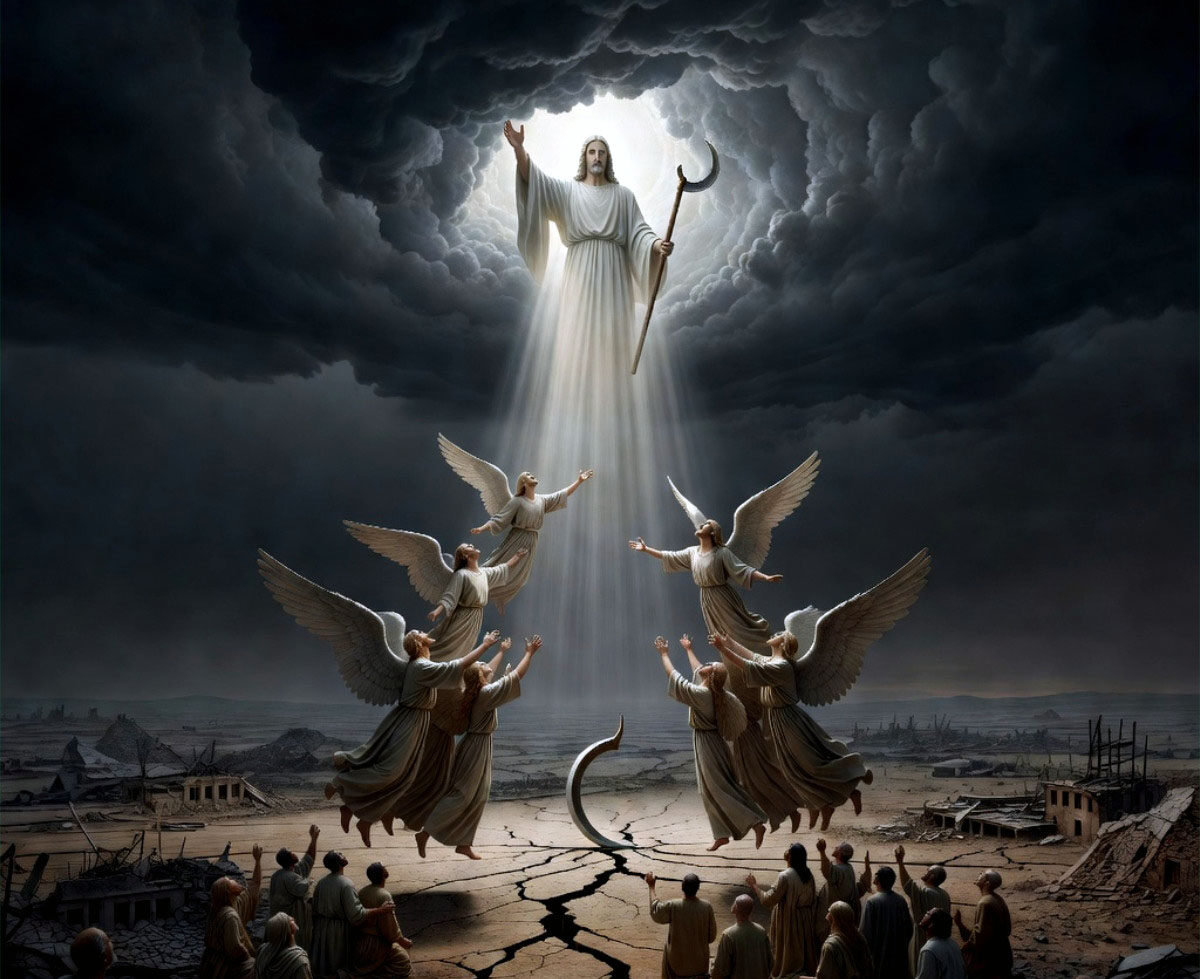
“And I looked, and behold a white cloud, and upon the cloud one sat like unto the Son of man, having on his head a golden crown, and in his hand a sharp sickle. And another angel came out of the temple, crying with a loud voice to him that sat on the cloud, Thrust in thy sickle, and reap: for the time is come for thee to reap; for the harvest of the earth is ripe. And he that sat on the cloud thrust in his sickle on the earth; and the earth was reaped. And another angel came out of the temple which is in heaven, he also having a sharp sickle. And another angel came out from the altar, which had power over fire; and cried with a loud cry to him that had the sharp sickle, saying, Thrust in thy sharp sickle, and gather the clusters of the vine of the earth; for her grapes are fully ripe. And the angel thrust in his sickle into the earth, and gathered the vine of the earth, and cast it into the great winepress of the wrath of God.”
Here is the pivotal hinge upon which the entire tribulation turns: two distinct harvests, reaped by two different agents, executed for entirely contrasting purposes, yet culminating in one simultaneous, defining moment of divine judgment.
| Grain Harvest (vv. 14–16) | Grape Harvest (vv. 17–20) | |
| Who reaps | The Son of Man (Christ) | An angel |
| What is reaped | The elect (the “earth” reaped of its harvest) | The “vine of the earth” (the wicked) |
| Purpose | Rescue — gathering the chosen | Judgment — casting into the winepress of wrath |
Christ personally gathers the grain, for He alone knows His elect whom He chose, promising, “I will receive you unto myself” (John 14:3). He delegates the rescue of His people to no angel. Conversely, the grape harvest—indiscriminate, without selection, casting the entire “vine of the earth” into the winepress—is entrusted to an angel.
The judgment is the reaping. Christ does not pour judgment onto the elect before gathering them; rather, He reaps the elect out of the field, and their removal is the judgment upon everyone left behind. The grape harvest represents the final execution of what the grain harvest has already determined.
This precisely mirrors the testimony of the Gospels. In Matthew 24:30–31, the Son of Man appears in glory—bringing judgment to the world and gathering His elect for the rescue of the church—at the exact same time. There is no temporal gap, no secret prelude, and no escape hatch.
Matthew 24:21–22
“For then shall be great tribulation, such as was not since the beginning of the world to this time, no, nor ever shall be. And except those days should be shortened, there should no flesh be saved: but for the elect’s sake those days shall be shortened.”
The “Great Tribulation”—representing the most severe period of the Tribulation—constitutes the final, catastrophic second half of the prophetic timeline. Yet, a divine separation occurs right at the crucial transition point: the final spiritual harvest of humanity takes place just as this era begins. According to scripture, the faithful elect are gathered and spared before the full wrath of God through his winepress.
The “Deliverance From Wrath” Is Real — But It’s From the Great Tribulation
1 Thessalonians 1:10
“And to wait for his Son from heaven, even Jesus, which delivereth us from the wrath to come.”
Revelation 3:10
“Because thou hast kept the word of my patience, I will keep thee from the hour of temptation, which shall come upon all the world, to try them that dwell in the earth.”
The “wrath to come” and the “hour of temptation” constitute the Great Tribulation—the final 42 months, the outpouring of the bowl judgments, the treading of the winepress, and the ultimate execution of divine justice. This is the period from which believers are promised deliverance: not the entirety of the seven-year period, but its most devastating culmination.
So here’s the honest math:
- Pre-trib view: You’re removed before any of it. Zero tribulation.
- What the text describes: You go through the first half. You stand. You endure. You are persecuted. And then, at the harvest — the Son of Man reaps you out of the field. You are gathered. And then the Great Tribulation begins, and you are not here for it.
You are still spared from the ultimate wrath. You are still kept from the hour of trial. You are still destined to be caught up and ever with the Lord. The distinction is that you are not granted an immediate escape from the tribulation of the world. Instead, you stand firm alongside it for a season. Then, at the appointed hour, you are gathered.
That position is a harder sell, which explains why the pre-tribulation version enjoys greater popularity.
Where the Pre-Tribulation Rapture Actually Came From
The pre-tribulation rapture is neither an ancient, unanimous, church-wide doctrine nor a belief held by the early church. It was not embraced by the Reformers, nor was it shared by the vast majority of Christians throughout 1,800 years of church history.
It came from one man.
John Nelson Darby (1800–1882), an influential Anglo-Irish clergyman and leader within the Plymouth Brethren, formulated the pre-tribulation rapture framework during the late 1820s and early 1830s. He isolated the “caught up” terminology of 1 Thessalonians 4:17, positioned it prior to Daniel’s seventieth week, and integrated it into a broader theological system known as dispensationalism, which separated Israel and the Church into distinct prophetic tracks.
Darby’s own words, written in 1850:
“It is this passage which, twenty years ago, [1830 AD] made me understand the rapture of the saints before — perhaps a considerable time before — the day of the Lord, that is, before the judgment of the living.”
He engineered the sequence. The pieces existed in Scripture, but the architecture was entirely his.
Then it was carried forward and amplified:
- C. I. Scofield — His Reference Bible (1909) printed Darby’s notes in the margins of the Bible itself. For generations of American evangelicals, Scofield’s marginal notes were their theology. The interpretation looked like it was part of the text.
- Dallas Theological Seminary (founded 1924) — Institutionalized the system in a major seminary, producing generations of pastors and teachers who carried it into pulpits across America.
- Hal Lindsey — The Late Great Planet Earth (1970) made the framework a cultural phenomenon. Millions of copies sold.
- The Left Behind series (1995–2007) — Sold over 65 million copies. Cemented the pre-trib rapture in the popular imagination.
One man’s interpretive framework. Printed in the margins of a Bible. Taught in a seminary. Turned into a bestseller. Adapted into a novel. And now marketed as “what the Bible actually says.”
The Comfort Problem
Let’s be honest about why this doctrine is so popular.
The pre-tribulation rapture essentially functions as an escape narrative. Believers are whisked away before the worst unfolds, sparing them from confronting the reality that God’s people also suffer, face persecution, and endure hardship alongside the rest of the world. In essence, it offers a guaranteed VIP bypass right from the start.
The alternative—the one the Gospels actually describe—is that Christians endure the initial trials alongside everyone else, face persecution, and are gathered only at the final harvest. This is a far more challenging and uncomfortable reality, requiring us to accept that God’s people must persevere through suffering.
Nobody wants to dwell on suffering. That is precisely why the pre-tribulation rapture gained such rapid traction. The text itself does not require this interpretation; rather, it is the audience’s deep-seated desire for escape that drives its popularity.
What the Bible Actually Says
Remove the dispensational framework. Remove Scofield’s notes. Remove Left Behind. What remains?
- Jesus describes one coming. Visible, glorious, unmistakable. (Matthew 24:27, 30)
- The elect are gathered at that coming, after the tribulation of those days. (Matthew 24:29–31)
- The Son of Man personally reaps the grain harvest; an angel reaps the grape harvest. (Revelation 14:14–20)
- The dead in Christ rise first, then the living are caught up. (1 Thessalonians 4:16–17)
- Believers are delivered from the wrath to come. (1 Thessalonians 1:10)
- Believers are kept from the hour of trial. (Revelation 3:10)
All of these elements converge. One coming. One gathering. One definitive moment where the elect are delivered and the world faces judgment. You will not face the Great Tribulation. You will be spared the bowls of wrath, the trodden winepress, and the ultimate wrath of God. Yet, you remain through the initial trials. You stand firm, you endure, and when the final harvest arrives, the Son of Man gathers you from the field to be ever with the Lord.
Tribulation Timeline – When Christians Depart
BEFORE THE TRIBULATION
| # | Event | Scripture |
| 1 | Gospel of the kingdom preached to all nations | Matthew 24:14 |
| 2 | A “falling away” (apostasy) occurs | 2 Thessalonians 2:3 |
| 3 | The Restrainer is “taken out of the way” | 2 Thessalonians 2:7 |
| 4 | Antichrist signs a 7-year covenant with Israel | Daniel 9:27 |
| 5 | Temple rebuilt; daily sacrifice operating | Daniel 9:27; Daniel 12:11 |
YEARS 1–3½ (FIRST HALF)
| # | Event | Scripture |
| 6 | 1st Seal — White Horse: conquest | Revelation 6:2 |
| 7 | 2nd Seal — Red Horse: war | Revelation 6:3–4 |
| 8 | 3rd Seal — Black Horse: famine | Revelation 6:5–6 |
| 9 | 4th Seal — Pale Horse: death; ¼ of earth slain | Revelation 6:7–8 |
| 10 | 5th Seal — Martyrs cry for vengeance | Revelation 6:9–11 |
| 11 | 6th Seal — Great earthquake; sun dark, moon like blood, stars fall | Revelation 6:12–14 |
| 12 | 144,000 sealed from the tribes of Israel | Revelation 7:2–4 |
| 13 | Great multitude before the throne | Revelation 7:9–17 |
| 14 | 7th Seal — Silence in heaven; 7 angels receive trumpets | Revelation 8:1–2 |
| 15 | 1st Trumpet — Hail and fire; ⅓ earth, trees, grass burned | Revelation 8:7 |
| 16 | 2nd Trumpet — Burning mountain into sea; ⅓ sea becomes blood | Revelation 8:8–9 |
| 17 | 3rd Trumpet — Star Wormwood; ⅓ waters bitter | Revelation 8:10–11 |
| 18 | 4th Trumpet — ⅓ sun, moon, stars darkened | Revelation 8:12 |
| 19 | 5th Trumpet — Locusts from the Abyss; torment for 5 months | Revelation 9:1–12 |
| 20 | 6th Trumpet — 200 million horsemen; ⅓ mankind slain | Revelation 9:13–21 |
| 21 | Little book eaten; “there shall be time no longer” | Revelation 10:1–11 |
Christians are on earth. Present. Enduring.
MIDPOINT — YEAR 3½ (THE HINGE — THE HARVEST)
| # | Event | Scripture |
| 22 | Antichrist breaks the covenant | Daniel 9:27 |
| 23 | Daily sacrifice ceases | Daniel 9:27; Daniel 12:11 |
| 24 | Abomination of Desolation set up in the temple | Daniel 9:27; Daniel 12:11; Matthew 24:15 |
| 25 | Antichrist sits in the temple, declaring himself God | 2 Thessalonians 2:4 |
| 26 | Antichrist fully revealed as “the man of sin” | 2 Thessalonians 2:3 |
| 27 | Beast’s 42-month authority begins | Revelation 13:5 |
| 28 | Woman flees into wilderness for 1,260 days | Revelation 12:6, 14 |
| 29 | Two Witnesses begin 1,260-day ministry in sackcloth | Revelation 11:3 |
| 30 | Mark of the Beast imposed; no buying or selling without it | Revelation 13:16–17 |
| 31 | Three angels’ messages proclaimed (everlasting gospel; Babylon fallen; warning against the mark) | Revelation 14:6–12 |
| 32 | The Harvest — Son of Man reaps the elect; the earth is reaped | Revelation 14:14–16 |
| 33 | Dead in Christ rise first | 1 Thessalonians 4:16 |
| 34 | Living believers caught up together with them in the clouds | 1 Thessalonians 4:17 |
| 35 | “At the last trump” — the dead raised incorruptible, the living changed | 1 Corinthians 15:51–52 |
| 36 | Angels gather the elect from the four winds with a great sound of a trumpet | Matthew 24:31 |
| 37 | Michael stands up; people delivered; the dead awake | Daniel 12:1–2 |
| 38 | The grape harvest — angel reaps the vine of the earth; cast into the winepress of the wrath of God | Revelation 14:17–20 |
| 39 | “Great tribulation” begins — the second half | Matthew 24:21 |
Christians are GATHERED. The Son of Man has reaped them.
YEARS 3½–7 (SECOND HALF — “GREAT TRIBULATION”)
| # | Event | Scripture |
| 40 | 7th Trumpet — “The kingdoms of this world are become the kingdoms of our Lord, and of his Christ” | Revelation 11:15 |
| 41 | Temple of God opened in heaven; Ark of the Covenant seen | Revelation 11:19 |
| 42 | War in heaven; Satan cast out to earth | Revelation 12:7–9 |
| 43 | Beast from the sea; Beast from the earth (False Prophet) fully active | Revelation 13:1–18 |
| 44 | 7 angels come out of the temple with 7 bowls | Revelation 15:5–8 |
| 45 | 1st Bowl — Foul sores on those with the mark | Revelation 16:2 |
| 46 | 2nd Bowl — Sea becomes blood; all sea life dies | Revelation 16:3 |
| 47 | 3rd Bowl — Rivers and fountains become blood | Revelation 16:4–7 |
| 48 | 4th Bowl — Sun scorches men with fire | Revelation 16:8–9 |
| 49 | 5th Bowl — Darkness on the beast’s throne | Revelation 16:10–11 |
| 50 | 6th Bowl — Euphrates dries; kings of the east march to Armageddon | Revelation 16:12–16 |
| 51 | Two Witnesses killed by the beast from the Abyss | Revelation 11:7–8 |
| 52 | Two Witnesses’ bodies lie in the street 3½ days | Revelation 11:8 |
| 53 | Two Witnesses resurrected; ascend to heaven in a cloud | Revelation 11:11–12 |
| 54 | 7th Bowl — Greatest earthquake; great city divided; islands flee; mountains not found; hailstones of a talent | Revelation 16:17–21 |
| 55 | Fall of Babylon the Great — destroyed “in one hour” | Revelation 18:1–21 |
| 56 | Marriage supper of the Lamb | Revelation 19:6–9 |
Christians are NOT here.
THE RETURN OF CHRIST (END OF YEAR 7 — THE FINAL BATTLE)
| # | Event | Scripture |
| 57 | “Immediately after the tribulation of those days” | Matthew 24:29 |
| 58 | Cosmic signs: sun darkened, moon no light, stars fall, powers shaken | Matthew 24:29; Revelation 6:12–14 |
| 59 | Sign of the Son of Man in heaven; all tribes mourn | Matthew 24:30 |
| 60 | Christ descends on a white horse — Faithful and True, King of Kings, Lord of Lords | Revelation 19:11–16 |
| 61 | Armies of heaven follow on white horses | Revelation 19:14 |
| 62 | Christ’s feet stand on the Mount of Olives; mountain cleaves | Zechariah 14:3–4 |
| 63 | The Wicked destroyed by “the brightness of his coming” | 2 Thessalonians 2:8 |
| 64 | Beast and False Prophet taken, cast alive into Lake of Fire | Revelation 19:19–20 |
| 65 | Remaining armies slain by the sword from Christ’s mouth | Revelation 19:21 |
| 66 | Fowls feast on the dead | Revelation 19:17–18, 21 |
| 67 | Satan bound with a chain, cast into the bottomless pit | Revelation 20:1–3 |
The final battle. The last act of the war. Satan is bound. It is over.
The Bottom Line
Believers remain on earth throughout the first half of the tribulation. We are not quietly removed in secret before it begins. Instead, we stand firm, endure, and face persecution. We witness the breaking of the seals, the sounding of the trumpets, the shattering of the covenant, and the standing of the abomination.
However, we are not to be afraid.
Matthew 28:20
“And lo, I am with you alway, even unto the end of the world. Amen.”
Jesus never declared, “I will be with you until I return, and then I will leave you once more.” Instead, He promised to remain until the very end. And that end is not a distant, abstract moment in the future; rather, it is the harvest. It is the exact instant when the Son of Man swings His sickle to gather the elect from the field. It is the moment when the dead in Christ rise first, and believers are caught up together in the clouds. The end is quite simply the glorious moment of His arrival to take us home.
He walks beside us through every single day leading up to that final hour. Through every seal opened. Every trumpet sounded. Every wave of persecution. Every dark night when tomorrow is uncertain. He is with us. Not watching from afar. Not present merely in spirit. He is with us personally and intimately. The very same Jesus who promised, “I will come again, and receive you unto myself” (John 14:3), is the exact same Savior who declared, “I am with you alway, even unto the end.”
And then—the final harvest. The Son of Man plunges His sickle into the earth, and the reaping begins. The dead in Christ rise first, and the living are caught up together in the clouds. His chosen ones are gathered from the four corners of the earth. Yet in that very hour, another angel reaps the vine of the world, casting it straight into the terrifying winepress of God’s righteous wrath.
That is the judgment. The removal of the elect is the ultimate reckoning for the world. Those who remain are those who were left behind.
Following that, the Great Tribulation commences—comprising the bowls, the winepress, and the final 42 months of divine wrath—and we will not be here to experience it.
Revelation 3:10
“Because thou hast kept the word of my patience, I will keep thee from the hour of temptation, which shall come upon all the world, to try them that dwell in the earth.”
We are promised deliverance from the hour of trial—not from all suffering, but from the Great Tribulation. We are spared the worst of it, shielded from the final execution of wrath.
At the culmination of the seven years, Christ descends upon a white horse, bringing a decisive end to the conflict. The beast is cast into the Lake of Fire, the opposing armies are defeated, and Satan is bound and cast into the abyss, signaling the final victory.
But we were already home. We were gathered at the harvest. We were caught up in the clouds. And now we are ever with the Lord.
1 Thessalonians 4:17
“Then we which are alive and remain shall be caught up together with them in the clouds, to meet the Lord in the air: and so shall we ever be with the Lord.”
That is the promise: not an escape from where we started, but a final gathering together. And He walks with us until that day comes. Through every trial, every dark night, and every moment in between, He remains by our side until His return.
“I am with you alway, even unto the end of the world. Amen.”
Leave a Reply