
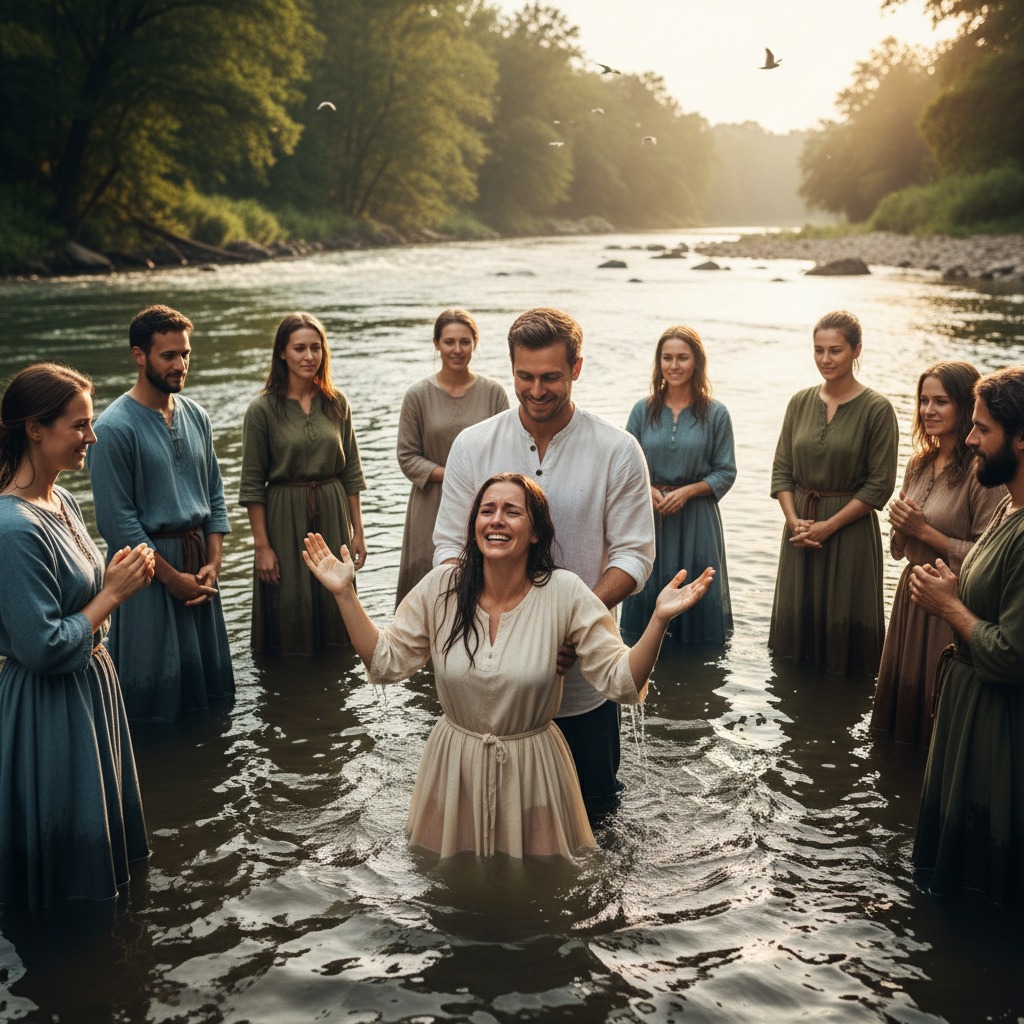
Does the Method of Baptism Matter?
Across various Christian traditions, baptism is primarily administered in two ways. The first is full immersion in water, which may take place in a natural setting like a river or lake, or within a dedicated basin such as a baptismal font, hot tub, or specially designed tank. The alternative is affusion, or having water sprinkled over the head, typically performed inside a church. This raises an important question: Is there a definitively correct method, or does the mode matter?
Let us consult the Scriptures for guidance.
A Case for Full Submersion
While the King James Version does not explicitly use the phrase “you must be submerged,” the underlying Greek word baptizō literally means to immerse, submerge, or dip. Rather than translating the term, the KJV translators chose to transliterate it. Notably, the distinct Greek word for “sprinkle”—rhantizō—appears four times in the New Testament (Hebrews 9:13, 9:22, 9:23, and 10:22), yet it is never associated with baptism.
Every instance of baptism described in the King James Version points toward a single destination:
Matthew 3:16
“And Jesus, when he was baptized, went up straightway out of the water: and, lo, the heavens were opened unto him, and he saw the Spirit of God descending like a dove, and lighting upon him:”
This is the baptism of Jesus—the supreme model for all believers. The crucial detail is captured in the phrase, “went up straightway out of the water.” The word “straightway” denotes immediate action. He emerged from within the water. The original Greek preposition translated as “out of” (ek) confirms that He was entirely immersed before rising. It is impossible to come “up out of” the water without first being fully submerged.
The heavens parted and the Spirit descended the very instant of His emergence—not when the first drop touched His forehead.
Acts 8:36–39
“And as they went on their way, they came unto a certain water: and the eunuch said, See, here is water; what doth hinder me to be baptized? And Philip said, If thou believest with all thine heart, thou mayest. And he answered and said, I believe that Jesus Christ is the Son of God. And he commanded the chariot to stand still: and they went down both into the water, both Philip and the eunuch; and he baptized him. And when they were come up out of the water, the Spirit of the Lord caught away Philip, that the eunuch saw him no more: and he went on his way rejoicing.”
As the New Testament’s most thorough account of baptism, the narrative describes the chariot commanded to stand still. Two men then walk to the water and go down into it—both of them. The baptizer enters the water as well, and afterward, both ascend from it together.
If it were merely a matter of sprinkling, why would Philip have needed to enter the water? Why would the chariot have had to come to a halt? Why would the scripture specify that both individuals descended into it? The imagery is unmistakable.
And observe: the Spirit whisks Philip away the moment they emerge from the water — mirroring the exact sequence in Matthew 3:16. The pattern remains unbroken.
John 3:23
“And John also was baptizing in Aenon near to Salim, because there was much water there: and they came, and were baptized.”
John chose this location because of the abundant water supply. While a mere bucket would suffice for a light sprinkling, a deep and plentiful body of water was essential for the repeated, full immersion of large crowds. The evangelist John, writing as an eyewitness, explicitly records this reason: the water itself was the very point.
Romans 6:3–4
“Know ye not, that so many of us as were baptized into Jesus Christ were baptized into his death? Therefore we are buried with him by baptism into death: that like as Christ was raised up from the dead by the glory of the Father, even so we also should walk in newness of life.”
Paul’s theology of baptism centers on a single, striking image: burial. When he writes of being “baptized into His death,” the preposition “into” (the Greek eis) signifies complete entry and descent beneath the water. To be “buried with him” is far more than a light covering or a mere symbolic gesture; it is a true burial, representing total enclosure.
Then the cycle reaches its completion: “raised up from the dead…walk in newness of life.” Descending into the water, plunging beneath the surface, and rising once again. Death, burial, and resurrection. This tangible physical act beautifully mirrors a profound spiritual reality.
Colossians 2:12
“Buried with him in baptism, wherein also ye are risen with him through the faith of the operation of God, who hath raised him from the dead.”
The verse opens with “Buried”—the striking first word—and immediately completes the cycle within a single sentence: “wherein also ye are risen.” The very act of burial is the moment of resurrection. It is one continuous, unbroken motion: down, under, up.
The Sprinkling Argument
The single biblical verse that advocates of sprinkling most frequently cite to support their practice:
Hebrews 10:22
“Let us draw near with a true heart in full assurance of faith, having our hearts sprinkled from an evil conscience, and our bodies washed with pure water.”
Taken out of context, it sounds like a prescription. However, the true meaning is entirely different.
The full passage (Hebrews 10:19–22) speaks of our boldness to enter the holiest place—the very presence of God symbolized by the Most Holy Place in the Tabernacle. Under the Old Covenant, only the High Priest was permitted to enter this sacred space once a year on the Day of Atonement, and only after sprinkling blood seven times before the mercy seat.
You no longer need an earthly High Priest. Through the shedding of His blood, Christ has accomplished once and for all what the old sacrificial system could only mimic annually. Your conscience has been sprinkled and thoroughly cleansed—just as the mercy seat of old. This transformation occurs not through outward rituals like water touching your head, but because Christ’s blood has fundamentally dealt with the root of your guilt.
The word “sprinkled” is rhantismos—the exact term Hebrews 9:13 employs for the ritual blood-sprinkling of the Tabernacle:
Hebrews 9:13
“For if the blood of bulls and of goats, and the ashes of an heifer sprinkling the unclean, sanctifieth to the purifying of the flesh:”
This serves as a metaphor for the cleansing power of Christ’s blood on the conscience, rather than a command regarding water baptism.
The phrase “our bodies washed with pure water” alludes to physical purification, mirroring the ritual cleansing performed by the priests prior to approaching the altar (Exodus 30:18–21), rather than signifying a specific mode of baptism.
In short: Hebrews 10:22 centers on gaining direct access to God’s presence through the finished work of Christ, rather than serving as an instruction manual on how to perform baptism.
Where Sprinkling Came From
The practice of sprinkling water as a mode of baptism lacks any biblical foundation, originating instead from extrabiblical traditions driven primarily by human convenience.
- The Didache (c. 100 AD) — prescribes immersion in running water. Allows pouring only “if thou hast not the water” — an emergency fallback, not the standard.
- Cyprian of Carthage (c. 250 AD) — first major church father to defend sprinkling as equivalent to immersion, citing OT cleansing rituals.
- Council of Ravenna (1311) — the Catholic Church officially declared pouring/sprinkling sufficient. Practical drivers: the sick, the dying, infants, cold northern climates.
- Calvin’s Geneva (1556) — authorized the minister to “take water in his hand and lay it upon the child’s forehead.”
- Westminster Assembly (1643) — voted 25 to 24 to admit sprinkling alongside immersion. The origin of sprinkling in most Presbyterian, Congregational, and mainline Protestant churches.
- King James I — brought Calvinist sprinkling from Scotland into English practice.
The Contrast
Scripture provides a clear and consistent pattern for Christian baptism. Every recorded account and descriptive act in the New Testament involves full water submersion. The few references often cited in favor of “sprinkling” are actually metaphors drawn from Old Testament blood rituals, rather than commands or examples for how water should be applied to a believer.
The practice of sprinkling was a human invention, born out of pastoral care for the sick, the dying, infants, and those facing harsh winters. While these were well-intentioned compromises, a practical concession does not equal a biblical mandate. The razor-thin Westminster vote of 25 to 24 reveals the deep division even among those who established the standard—they were simply splitting the difference.
Seek the Lord’s Guidance
When you open His Word, the Lord places a defining question before you: Will you choose His revealed will, or simply what is convenient?
Jesus entered the water, just as Philip and the eunuch descended into it. John intentionally chose a river because it offered an abundance of water. Paul vividly compared baptism to a burial—total, complete, and immediately followed by resurrection. The imagery points to far more than a symbolic sprinkle; it represents a full, transformative identification with Christ’s death, burial, and resurrection.
The Lord helps us discern between what is permitted in an emergency and what is commanded in the ordinary course of life. If you are able to be immersed—to go down into the water and come up—that is what the scripture describes, what the pattern establishes, and what you are invited to experience. Yet, if physical limitations or unfortunate circumstances prevent immersion, we can be confident that the Lord, in His endless compassion and ministry to the afflicted, extends His grace and finds that devotion acceptable.
Leave a Reply